Project
english version 1.31
Most projects to create a new digital currency fail because they rely on real money or on material wealth. This project aims to create a new digital currency based exclusively on the digital world.
Three basic rules :
Let us imagine that you become a digital world citizen. Just register in the Universal Digital System community to get UDC account and receive monthly income of 100 UDC. Now you can buy any digital goods you want : pictures, drawings, videos, songs, poetry, software tools, programs, software, lessons, letter templates, books... which are sold by their authors/creators/producers/owners at UDC pricing.
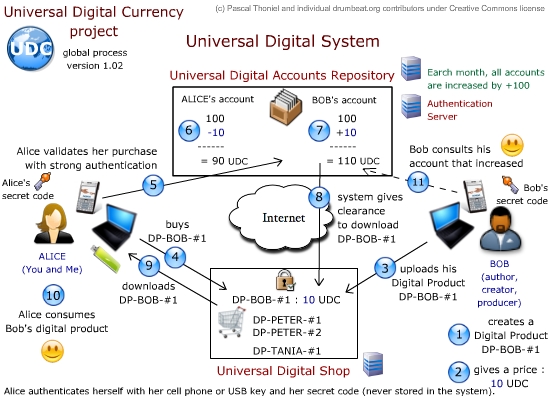
For example, you buy a picture for 10 UDC or an accounting lesson (text or video) for 50 UDC. Your balance account is debited while the seller balance is credited for 10 or 50 UDC.
Even if you don't produce and sell any digital goods, your monthly income gives you the capacity to buy digital goods. Of course, if you are a smart digital goods producer and lucky seller, your account would grow faster and you will be able to buy more digital goods. The more you produce and sell, the more you earn and the more you can buy digital goods. But everyone earns his/her Universal Digital Income of 100 UDC each month, whether producing digital goods or not. Thus no one is excluded from the system.
We just need to create a global web site responsible for creating and managing users' UDC accounts with users' strong authentication. This step will prime the pump.
Become a "Follower" ! If you have more time, your may contribute. It is easy. Just take a look at the « ToDo List » page in "links" area and then post a message or send me an email to "pascal@joocool.com".
Today, all individual digital goods authors/creators/producers have to cope with this alternative :
Each choice listed above has its corresponding drawback :
That is why UDS propose this new choice :
UDC is a monetary unit. A digital goods author/creator/producer/owner sets the price for his/her product using UDC. For example, I can sell my drawings for 5 UDC each and my newsletter for 10 UDC. All pricing is expressed in UDC unit. The deed of sale grants use rights and enjoyment to buyer without transfer of ownership.
No middleman or distributor : digital products are sold directly and exclusively from author/creator/producer/owner to consumer. One individual sells a digital product to another individual that consumes this product. Uploading digital products to electronic store is an act of consignment shop. Resale is prohibited.
Each digital product has an associated author/creator/producer/owner. A database registers the digital product (product code, name, description, ...) with the identifier of the author/creator/producer/owner. Thus, at a sale, the system automatically knows the ID of the seller whose account will be credited.
When a digital product is a joint effort, the IDs of all authors/creators/producers are attached to the product code. A coefficient can be assigned to each. Thus, for a product created jointly by A, B and C with coefficients A-5, B-3 and C-2 and that is sold 10 UDC, the system credits the account for A 5-UDC, for B 3-UDC and for C 2-UDC, while debits the buyer's account for 10 UDC.
With UDC units, you can buy and sell only digital goods, no real goods. Here is the list of digital goods you can purchase and sell, in alphabetical order.
List of digital goods (version 0.6) : action plans, assembly sheets, blueprints, e-books, course materials, drawings, e-newspapers, fonts, game programs, glossaries, instructions, lessons, lists (items by category), magazines, manuals, manufacturing records, movies, musical opus/works, newsletters, photographs, pictures, poetry, programs, recipes, ringtones, short films, short stories, software, software tools, songs, sounds, technical sheets, templates (contract, legal status, letter, ...), tip sheets, training materials, videogames, videos, widgets.
This list must be completed. List open to your suggestions.
A digital product is not a commodity like any other. It has a fundamental characteristic: its manufacturing cost per unit is zero. Like a hardware product, the cost of design and production exists. But once completed, its cost of re-production is zero, unlike the process of mass production of a material product. That is why an individual has the capacity to serve an important market with its digital production without raw materials, workshops and factories.
Some digital products are frozen, that is to say they will not change once made, like a poem, a picture or a movie. But others like programs, software, books, courses, etc. can evolve. Regular updates can improve the benefit of consumers.
Each digital product can be identified by a unique value. This "fingerprint" or hash is the result of a one-way hash function. This can be likened to the barcode of the products we buy in stores. With this unique and universal product code, our system can not make any mistakes on the product.
All UDC accounts are identical and there is no distinction between a merchant account and a personal account. UDC accounts are dedicated exclusively to individuals. It is not a matter of wether you produce and sell digital goods or not. UDC accounts are always free to open. Each member of the Universal Digital System community is allowed to get his/her 100 UDC income per month.
Cell phones and smartphones are good means to authenticate yourself and then access to your account balance and transaction details.
Few reasons :
A registered UDS member can also authenticate himself/herself to the system with its USB key plugged to a computer/netbook connected to Internet. In this case, a browser is enough. It is a Java applet, automatically downloaded and executed in browser, that allows users to authenticate with a simple USB key or hard drive (which will store a personal matrix) and entering a personal unbreakable code. So, using a mobile device is not mandatory.
All UDC account services are delivered as Web Services on the server side.
Universal Digital System (UDS) is not based on anonymity like it could be for digital coin systems. When a digital product is bought, UDS must know who buys and who sells in order to debit the buyer and credit the seller. Once operation is achieved, no log is kept by UDS in order to protect people's privacy. Account operation details (income-credit, purchase-debit, sale-credit) are written inside this account and are only visible for the account owner, after strong authentication. No commercial database is created about buyers and sellers. No information is collected, stored and used by UDS for advertising purposes.
We believe that everyone is worthwhile to receive income in order to consume cultural and educational products or something digital that is useful for life. This income is given on an equal basis to everyone. The counterpart to UDC monetary creation is the addition of people's personal values. Our belief is that the total value of humanity increases each time one of us "consumes" a cultural or educational product.
We think that creating a digital product corresponds to added value and wealth creation. Its price is the counterpart.
We think that « toute peine mérite salaire » and that an author/creator/producer must earn an income from his/her work and knowledge/know-how/talent. The UDC project aims to promote recognition and valorisation of "wealth" (expressed numerically) backed by people.
What can be got easily and for free is always worth less to us. Our system will promote ease of access to digital assets, while promoting digital creation and production. We believe it is possible to create an intermediate place between free and business, two irreconcilable worlds that oppose today.
Those who graciously put their creations and work available to others deserve our gratitude. But mostly, all these efforts are made by people who also have a real job properly paid by real money. This allows them to be the "volunteers" of the digital world. They dedicate a part of their leisure time and a monetary award, whether real or digital, is secondary. We welcome their presence in the digital world and salute their selflessness.
Others are self-employed, poor workers, unemployed, homemakers or students. Any extra work done for free in the digital world at the expense of their main activity is a real shortfall. This scenario is also true in the art world where the happy few eat a big cake while others, many more, eat only crumbs.
Of course our system does not reward these people with "hard currency" money. However, it allows them to obtain tangible recognition, dignity as an author/designer/worker, and also thrive in the digital world through the UDC won and spent to acquire other digital goods.
Universal Digital Currency does not intend to replace real money, it is a complementary currency. UDC issuing procedure is a mix between central distribution and backed currency.
UDC is distributed by a central office to everybody or, to be more precise, to everybody who register. It is that simple. « This is the way major currency reforms are typically introduced when a radical departure is necessary. » [Bernard Lietaer]
Until 1944, it was theoretically possible to redeem gold from the bank against the bank notes that have been formerly given. Today, you can withdraw cash from your bank account but you only exchange account digits against paper money. In Universal Digital System, you do not make any deposit on your account at the beginning. It is automatically credited by Universal Digital Income. So there is nothing to be redeemed since you have not made any deposit. But UDC is nevertheless a backed currency for it is directly and legally redeemable for digital goods or services. « The strongest currencies are typically those that are fully "backed" by a good or service. [...] Currencies that are fully backed by a good or service that is in broad demand have logically an easier time to gain credibility. » [Bernard Lietaer]
« The problem of over-issuing is the biggest risk run by currencies that are created by central issue. It is important with this model to cautiously control the quantity of currency issued, otherwise its depreciation and risk of loss of credibility is a predictable outcome. » [Bernard Lietaer] That is why the income amount given to registered people is modest and spread evenly over time. That is why the full part of used UDC (to buy) is backed by digital goods.
During initial phase, registration of new members in UDS community will feed the system with money creation, but according to a strict parity with members' number. Fine tuning of Universal Digital Income paid monthly to all can therefore control overall system. Wise and prudent management over time of Universal Digital Income avoids both glut and scarcity of UDC money.
UDS assumes a universal dividend money system (Universal Digital Income). So each individuals, present and future community member, will create the same relative amount of money (Money created / Monetary Mass / Individual) during a long time period.
Currently we find that average income in real money is different from one country to another. Is it inevitable? Should we also pay different Universal Digital Incomes across countries?
Price difference for same goods in different countries due to :
The advantage of digital world is that production place is irrelevant because anyone can instantly transmit files anywhere in the world thanks to Internet. There is no reason why price should be different from one region to another or from one country to another. Digital product, after its initial production, has the distinction of being re-produced "for free" every time it will be consumed again. So in digital world, mass production mode does not matter because everyone can mass produce by simple file copy. Similarly, scarcity is no longer a relevant criterion. Finally, a digital product for sale in a UDShop has only one "world" price that applies to consumers worldwide. It is the producer who sets the price. This award no longer depends on individual and social value/benefice consciousness of buyers, which varies according to regions and countries.
As a result, there is no reason why Universal Digital Income should be different from one region to another, or from one country to another, since digital purchasing power is exactly the same. Thus everyone will receive the same UDI equally.
1. Issuance
2. Transaction
3. Conversion/Co-function
4. Retirement/Redemption
Universal Digital System is a breakthrough, fostering wealth flow without any kind of exclusion, keeping currency issuing under control while making UDC strong and credible.
version 1.31 - 20110227 - (c) Pascal Thoniel and individual drumbeat.org contributors under Creative Commons BY-NC-SA license